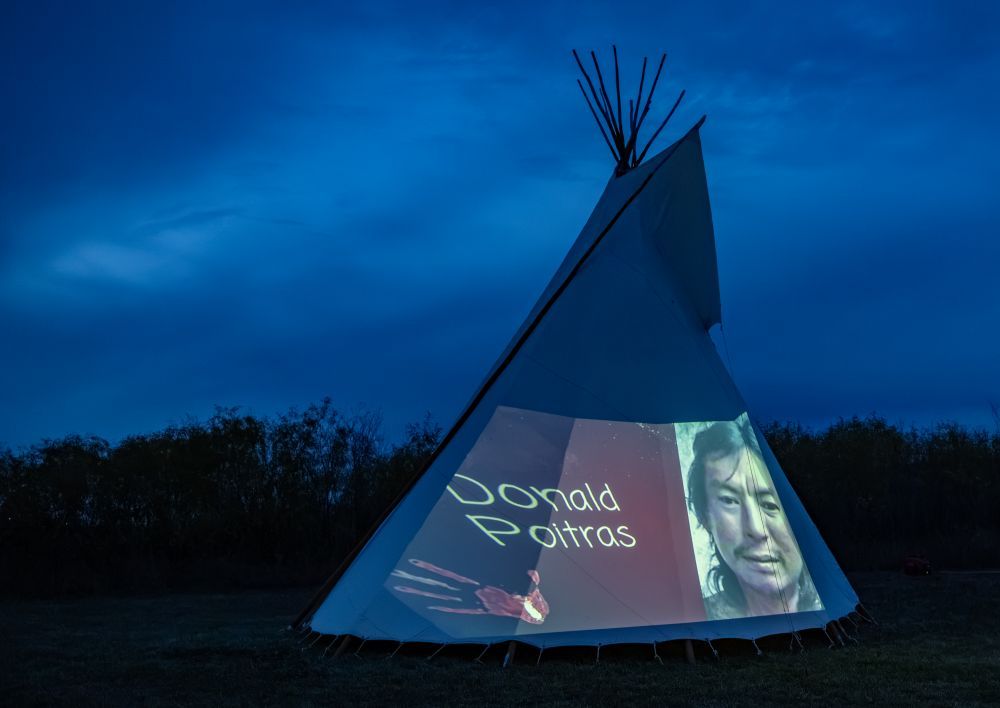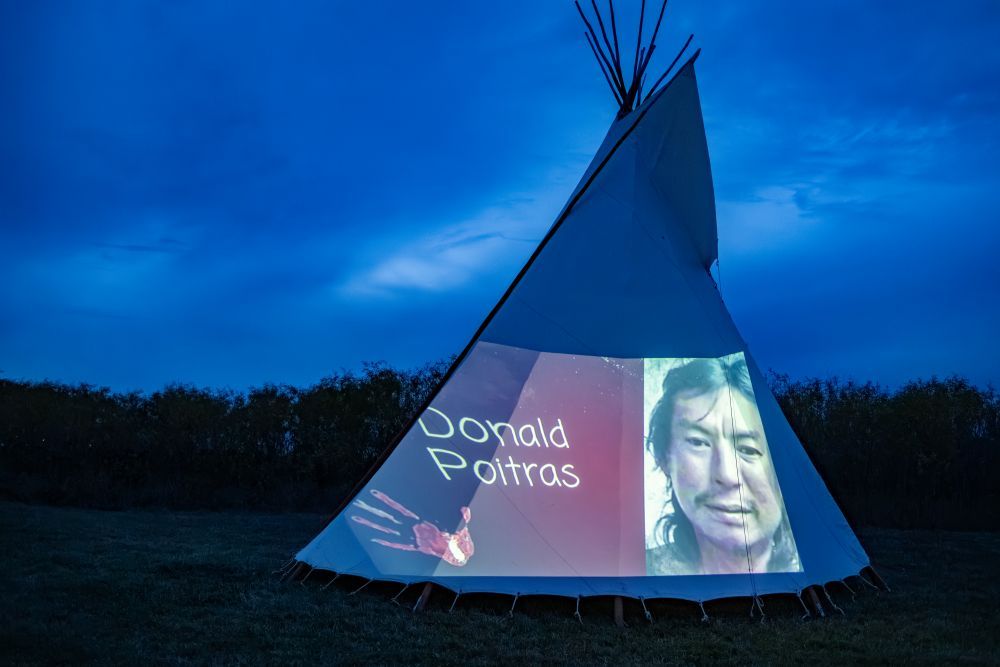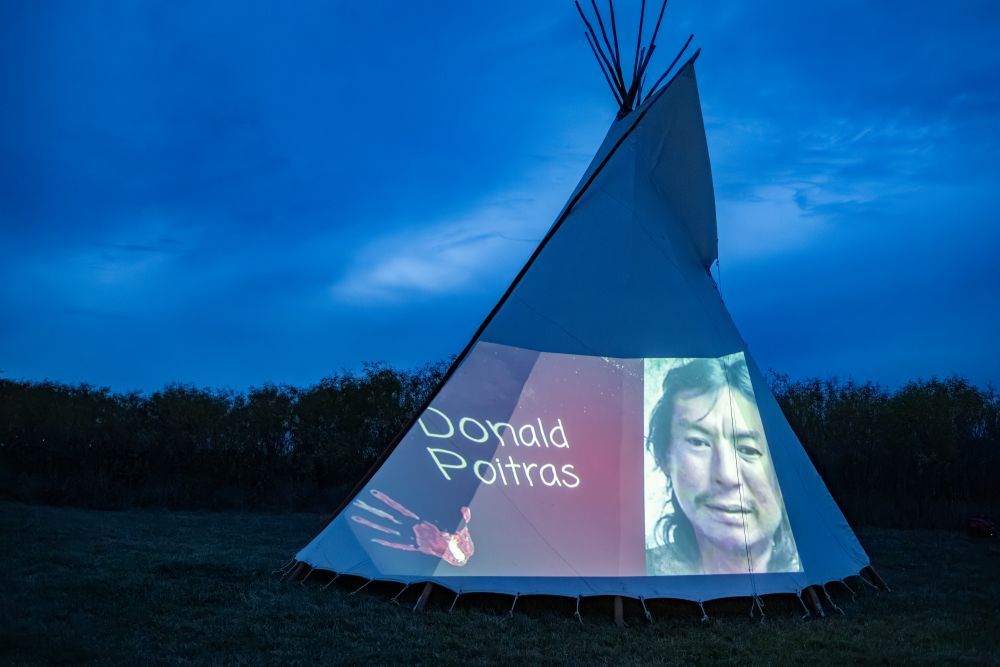



I actually started this from my late sister. She was a few years older than me. She wanted to do this. At the time it was the three of us when my brother Donald went missing in 2003, here in Fort McMurray. My sister is the one who called me when I was living west of Calgary, a place called Morley, Alberta. She called and told me our little brother was missing. That’s how I found out. I was really upset, right?
Read More About Jerry's Story Honouring His Brother Donald Poitras
The first thing I did was go looking for my brother. There’s Donald, Tom, and then me. We started by looking for Tom. It took about two weeks before I found him, because I didn’t know where he was living. He was in the same area, but they moved from house to house. Finally I found them, and I told them our brother was missing. He was visibly taken by it, because the two of them had been together.
Now look, I’m going back to 1970. Back then, the government, I don’t know if it was provincial or federal, wanted to assimilate us. They came at night to the place we were living here in McMurray, maybe 11:30, 12:30, or 1 in the morning, I forget. All of a sudden there was a big knock. My dad had gone to work, so they came when my mother was there alone. My mother doesn’t speak good English. She’s Dene. There were two RCMP officers and three other people, a social worker and two others. They scared my mom, I guess.
I didn’t know what was happening. My mother told me later what actually happened. I guess they told her they were there to take the kids. My late brother Terry, the oldest, would have turned eighteen in a couple of months, so they didn’t take him. But they took my sister Irene. They put her in a car and drove away.
No goodbyes, nothing. There was a lot of yelling going on, and my mom was badly shaken by what the police were doing.
I woke up in a room. We had a pretty big dog, and he was in the room with me. I heard screams, and I was wondering what the hell was going on. I called my mom, and she told me in Dene that the police and the people were there to take us, so I should hide. At the time I understood my language. I didn’t speak it, but I understood it. So I hid under the bed. It was built into the wall, so you couldn’t lift it up. I was just a little guy, eight years old, so I dug in under there. All I could hear was screaming. I could hear Tom, and I could hear Donald crying. Donald was a baby at the time, maybe three or four years old. They took Tom away. I didn’t even see them go. They just took him away.
So far they had taken Irene, Tom, and Donald. Now I was the last one they were trying to get. I know this is not about me, but they came to take me, and they couldn’t, because of the dog. Every time the police came near, he would growl or try to bite them, because he was guarding me. My mom said it was okay. I didn’t want to go. The next thing I knew, they put her in handcuffs. I saw that. They forcibly took her out of the house and put her in the RCMP car. I remember she told me to go. I really didn’t want to go.
After that, for seven years, I didn’t see my parents or my siblings. They kept me in one place for about a year, I think. Then they took me to Edmonton, with an RCMP officer and a social worker. They said, “You’re going to be staying with this family.” They were Caucasian. They were already elderly, Hungarian, and they didn’t speak English very well. Obviously I was a little scared. But always in my mind I thought about Tom and Donald.
I’m talking about myself so much, but what happened to me, I believe, happened to my brother Donald. Donald and Tom were together. From what I can recall, Tom told me that when they got there, the first thing they did was make them take a bath in bleach, like they used right back then. It was part of the assimilation. Part of the genocide, I don’t know. They kind of succeeded, in a way, because I lost my language. It was a dark moment, and it took years and years for me to overcome that. I’m sure it was the same for Donald. They had to bathe in bleach to make them more white, more Caucasian. Then they had brush cuts, and they were thrown in a room. That’s what I recall from what Tom told me.
They ended up staying on that farm for seven years without seeing anybody. For Donald, his first memory is that place, from when he was a baby and his eyes started to open. He only saw Caucasian people at the time. They were also elderly, also with speech problems. Tom always had to work hard. They did hard labour. When Donald got old enough, he started doing chores. In 1970 I was about eight and a half, almost nine. Tom would have been six, and Donald three or four. So when he was a little guy, he had to do house chores, like the garbage. That’s what he remembered. They were strict.
I don’t know if you’ve heard of Richard Henry Pratt in 1892. He said the way to assimilate the Indigenous people was to take the Indian out of the man, so he could fit into white society. Well, yes, they were successful in some ways. What happened to them happened to me, too. I lost my language. They lost their language. Tom used to tell me they would get whipped sometimes. They were always told they were nothing but savages. That’s how they referred to us back then. It’s all part of the genocide, the assimilation. They opposed us trying to speak our language. I remember, because I lived there when I was older, if I said a swear word in my language, they would get really upset, visibly and even physically. So I would imagine it was the same for Tom, and for Donald, maybe not as much, because Tom was older. They were held accountable. They would get privileges taken away.
Donald came back in 1978. I came back on the fourteenth of March, 1977. I was turning sixteen. I was so happy to come home, finally. Even through all those years, I had always remembered my parents. I remembered my culture, the way my parents, because they were bush people, taught us a lot about nature and stuff like that. That’s something they could never take away from me. I would imagine it was the same for Tom and Donald.
When Donald came back in 1978, he didn’t recognize anybody. He didn’t recognize me, or my late sister, or my oldest brother, Terry, or my dad. But when he saw my mother, something was triggered. It’s like a bond between mother and child. He knew he was home. He would have been twelve or thirteen, probably in elementary school. From what I know, he was a smart, talented boy. In school he did all right. He was easygoing. Once you got to know him, he was a good friend. That’s the kind of person he was.
My sister was the last one to come back, in 1979, after all those years, even though she was much older.
In those years, the seventies and early eighties, Fort McMurray was a boom town. Back then it was GCOS, which is now called Suncor, and Syncrude. McMurray was like a party town, right? My father was still working. We had a house and we had a trailer, and we were all together as a family. I think we were happy, because I can remember happy moments as a kid. Tom and I would play. Donald was a little too young, but Tom and I would play. The family bond was strong. Food was always provided. We had security. So I would imagine that for Donald, too, during that time. I started drinking back then. He had his buddies to hang out with, too.
I know I’m skipping a lot of time here. In 1995 I had a relationship, and I moved away from McMurray to Morley.
Meanwhile, Donald was a working man. He maintained a job. Our parents passed away, by the way. My father passed away in 1998. My mother passed away in 1999. So Donald had to be responsible for maintaining the lot rent, the insurance, the food, and his job. He did that. He was a Type 1 firefighter. He did initial attack. He worked with Alberta Forestry. From what I know, he was a good worker. They would go for a month at a time, twenty-eight days, or sometimes even longer, wherever they had to go. He maintained the lot rent. He maintained his security. When he got back, yes, he had his booze. But he didn’t drink to get excessively toxic. He drank just to feel good. I myself never drank with my brother, but from what I recall, Donald always maintained his composure. He was not that guy. He had himself together pretty well.
When I got the news of Donald missing in 2003, I was pretty shaken up. I knew him. He was responsible. You wouldn’t just get up and leave the job and the trailer and everything. He thought of it as our home. It was our home. My father bought that trailer. We were renting the land, the lot.
After I found them, my older sister and Tom and I, while we were all alive, got together. My sister, being the oldest, wanted to do what I’m doing now. She said we should have closure. It was 2003, then four, five, six, seven, eight, nine, ten, eleven. Maybe 2012, I’m not sure. It’s on a family video. I saw it. Tom and Irene said, “I think it’s time we have closure for our brother,” because we hadn’t found him. But the RCMP told my sister, and told me, that Donald was seen in Fort Saskatchewan in 2007 or 2008. They said they stopped him four years later, and that the guy was Donald Poitras.
When the sergeant told me, because I talked to the RCMP, I thought the sergeant was wrong. He said, “Do you know your brother was stopped at Fort Saskatchewan?” I said, “How do you know it’s Donald?” He said, “Yeah, I see the name is Donald.” I said, “Well, that’s you saying that.” As an officer of the RCMP, wouldn’t he know that Donald was on the missing list? Why didn’t he take a picture of Donald? I forgot to tell you that Donald was in a fire. He got burned, third-degree burns, so he had some burn marks on his face. So I asked, “How do you know that was Donald? Did he have burn marks on his face?” The sergeant said, “Yeah, he had burn marks.” So it can’t be. You have to remember that when he was supposedly seen in Edmonton by the RCMP, he was on the missing list. He had his picture on the missing list. When the police supposedly saw him or stopped him in 2007, they took him off the missing list without consulting my sister Irene. She was alive at that time. I found this out years later, what the RCMP did. I said, “How could that be, that the RCMP supposedly stopped him in 2007 or 2008?”
And again, I forget what year, 2013, he was supposed to be seen again in Edmonton. In 2014 or 2015, he was supposedly stopped by city police on a C-Train. That’s all bullshit.
I want to go back to 2007 or 2008, when he was supposed to be seen. There were a lot of people from Fort Chipewyan living in Edmonton who knew Donald. We have family up there, relatives, cousins and stuff like that. I live in Edmonton. Why would Donald just be hanging out and not come to see any of the family, or try to notify any of us? He knew the phone numbers of the family. He would have notified somebody. But from 2003, 2007, all those years, it was a blank.
The RCMP actually got me motivated to continue this for Donald’s peace of mind. My sister wanted to do that, for closure. I’m the last living sibling in the family, because the parents and all the siblings are gone. I’m the only one. I feel it’s my obligation, I need closure for Donald. So I held a little burial ceremony for him, even though it’s only a picture. Imagine, from 2003 until now, 2026, that’s practically twenty-three years. None of the family saw him. I didn’t see him. I looked all over for him in Calgary when he was supposedly seen in Calgary. So did my brother Tom, and other people from Fort Chipewyan who lived in Calgary at the time. Nobody saw Donald. Same thing in Edmonton, in 2007 or 2008. No one saw Donald. So why is it just the police?
They make him look like he’s a big drunk, an irresponsible human being. He’s not irresponsible. He was a responsible man. Donald was a good man, a nice guy. He always kept his responsibilities. For the police to depict him as nothing but a drunk, a drunken Indian, that’s the stereotype we get, our generation especially, other Indigenous people like myself, so many others. We’re automatically stereotyped. To this day, if I walk into some place, they’ll stop me and ask, “Did you have something to drink?” I’ll say no. It’s probably the same with Donald.
He had friends. When people, his friends, needed help, he would help them out. If you didn’t have a shirt, he would give you one. That’s Donald. He was a kind, easygoing guy.
I think it was 2002, the last time I saw him. Tom and I and Donald were all together. Donald bought us breakfast. He was real happy, because he said he had met a girl. I told him, “Tom, it’s good. I’m glad you found a friend. I think our parents would be happy for you.” I was travelling a lot then. That was the last time I saw him. When he went missing, I really don’t know how or what happened to him. Obviously he made the news. I think his name and his picture were in the Sun paper way back then. The Fort McMurray paper also had an article about Donald, but it was just a small little article. They never publicized it much.
My whole purpose, like I said earlier, is so that through us, he can be at peace. In our culture, the spirit could still be out there, right? As far as I know, I’ve been sober for many years, since the 1980s. I never heard or saw my brother. My sister passed in 2016, and my brother Tom passed in 2018. They both passed knowing that Donald was still missing. When we did talk, they would always say, “We need closure for Donald.”
I started this journey in 2019, just before COVID. How I started was I called the RCMP, because I didn’t know how to go about it. I told them I wanted to put him back on the missing list, and I’m still trying to get him back on it after all these years. There’s a barrier to getting closure for him, because the RCMP believe he’s still alive. They say he was seen in 2007, 2012, 2013, and in Calgary. Why is it only the police who see him? And if they saw him, why didn’t they notify me? They knew where I was living. They knew how to get hold of the family. They could have come and told me, “Hey, your brother was seen in Calgary.” When they told me that, I questioned the RCMP. Why didn’t you take a picture of him? Why was nothing being done? That’s the really funny thing.
To conclude, I want this journey just for my brother, for Donald. I want Donald to be at peace in the spiritual world, so I can lay him to rest. By doing that, I believe my sister and my brother would be happy that his spirit is finally at rest. My goal is to get that certificate.
We’ve been victims since we first heard he was missing. It was traumatizing for all of us, for my sister, my brother, and myself. We were victims of this. The police have to know that I’m still a victim. I need to get this clarified. I want to get more public awareness out there for Donald. That’s what this is about. I really appreciate it. Thank you, Renee, for doing this.
Even though it’s been that many years, I’ve stayed sober. I didn’t take drugs. It’s still a healing process, still a healing journey. But by doing this, I feel it’s a healing journey for the whole family, not only for myself, but for Donald, for Irene, for Tom. Once we get that closure, I think it will be a good thing.