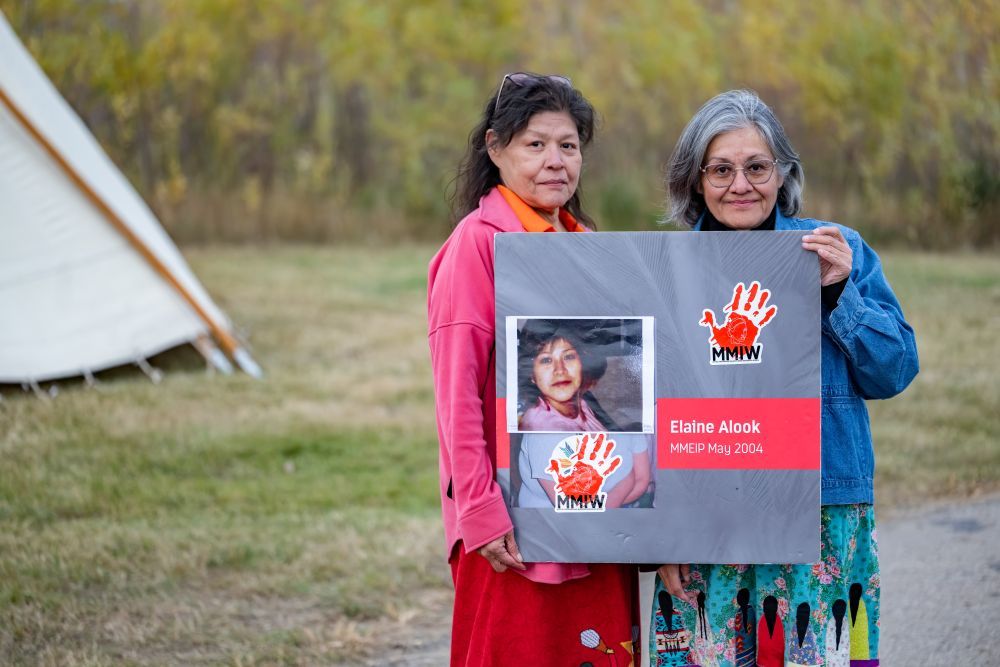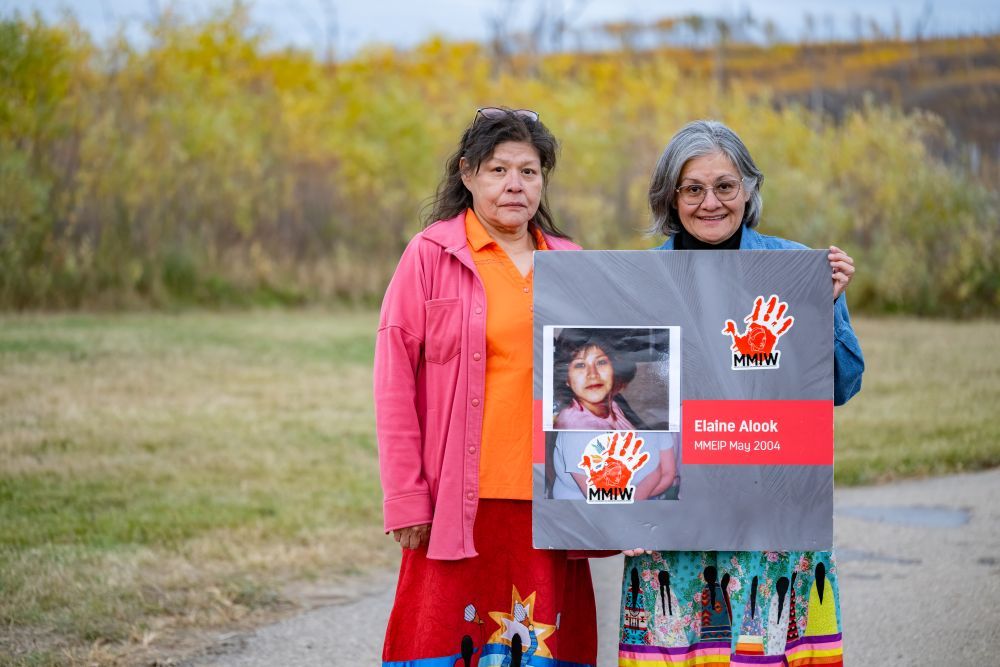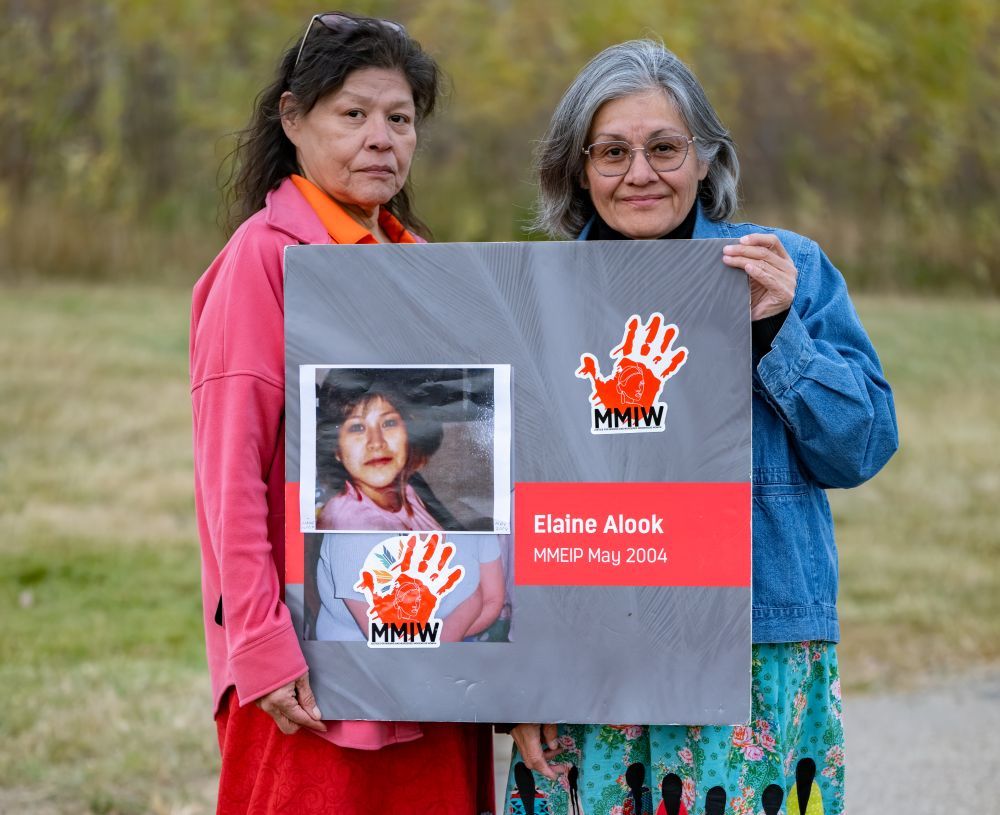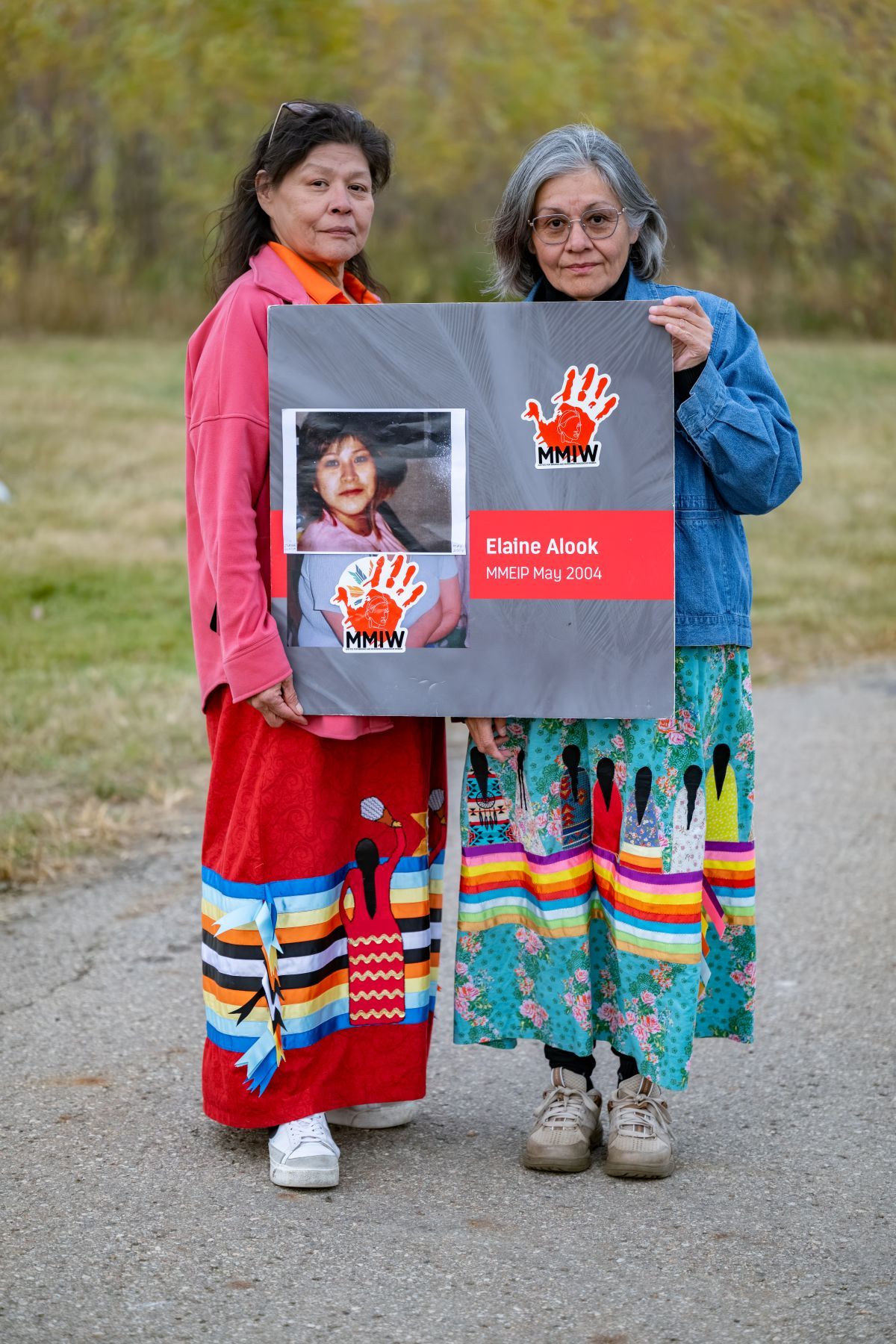




Janet:
Elaine was the youngest girl in our family, the baby. We never had dolls growing up. We only had one in my whole life. She was our little doll. Me and my sisters would play, you know, kings and queens, and she’d be the princess. We would dress her up and stuff like that. There were ten of us in the family, and we couldn’t afford gifts. We weren’t really into Christmas gifts.
Read More About Janet and Noella's Story Honouring Their Sister Elaine
Janet: Elaine was the youngest girl in our family, the baby. We never had dolls growing up. We only had one in my whole life. She was our little doll. Me and my sisters would play, you know, kings and queens, and she’d be the princess. We would dress her up and stuff like that. There were ten of us in the family, and we couldn’t afford gifts. We weren’t really into Christmas gifts.
I was older, and the siblings below me had a different upbringing. They moved to Fort McMurray when my dad got a job here, but us older siblings, we didn’t have that much. We were on a farm growing up. With my background, we lived in a canvas tent during the winter in High Level, because somebody wanted to rent the place we had. Then my dad bought this log house on a farm. Previous to that, we lived at the airport in Fort Vermilion. My dad built a house there with my cousin, and we lived there. Then he bought this farm, and we had horses and cattle. He put the foundation in with my cousin Leo Lewis, bought a mobile home, and built it up.
We weren’t doing that good. He wasn’t working that much, because he only trapped during the winter. It was a different lifestyle compared to what my younger siblings endured growing up. When my father got a job in Fort McMurray, he moved all of us. It still wasn’t the same, because we liked the farm, and we had horses, cattle, all the farm animals. Moving to Fort McMurray was like a culture shock. There weren’t relatives close by. It was all strangers, right? We lived in a townhouse in Timberlea, and it was really small. Then my dad got into a house purchase program, and he bought a house. My younger siblings all went to school in the city, whereas I went to residential school, then day school, and then boarding school. It was different.
Noella: We were separated. My older sisters all had to go away for school, so it was just the youngest ones of us. There’s a big age gap between Janet, the older sister, and Elaine, the younger sister. She was born three years younger than me. I was in Birchwood, and she was in the other school up in Thickwood. We weren’t all in one school, because we were in Fort Vermilion to begin with, right?
She was the baby of the family, like Janet said. There are ten of us, so she probably got a lot of attention from Mom and Dad, their baby girl. We were pretty close. We looked after each other when we were here, because there was still a lot of negativity towards Native people. I endured a lot of that the first years I came here from a farm, country life. I was probably traumatized from how I was treated, and probably the same in her school. There weren’t very many Native people. Right away, that’s how we grew up, just trying to advance, you know, try to live in it.
But we’re still a close-knit cultural family. I remember we used to take Mom to do her hides on the river at the bottom of Thickwood. Elaine was always helpful. She had friends here, two twin friends that she met again years later in Medicine Hat, and they had been her friends growing up in elementary school. She was a bubbly person, very outgoing, with a big heart. I’ve never heard her call anybody names or anything like that growing up. She was always outgoing and just a really happy person. She has four boys, and she was a single mother at times.
Janet: I remember one time, being a single mother wasn’t easy for her. She wanted to go to school. She wanted to push through to a higher education, and maybe be a hairstylist, because she liked to fix her hair a lot. She always did. She couldn’t afford the rent, and she ended up in a shelter for battered women. The father of her children refused to pay rent, and at Christmas time I went and got her some gifts. I said, “Why?” She said she had no place to live with four kids. He was working, and he’d rather pay for an eight hundred dollar tattoo for himself than pay rent for his wife and kids. He was just that type of person, all me, me, me. It saddens me to see my beautiful baby sister going through that. I won't ever forget it. During Christmas she had nowhere to go with four kids.
Noella: And our mother wasn’t educated. She spoke almost everything in Cree, her language. She didn’t read or write. I remember I had to write my own notes so I could go into baseball, soccer, or whatever. She never went into our schools. That’s the kind of background we had. We had to go fend for ourselves and learn things ourselves, to educate ourselves and try to live. Sometimes we picked the wrong people to associate with and made wrong choices. There was nobody we could have turned to. There were no liaison workers back then, in the eighties and nineties. There was no help.
Now I see help, but nobody sees it. Awareness has to be brought up more for the people that are coming from the reserves, the women, the men, whoever wants to pursue education. They don’t know where to turn, what avenues there are. As soon as that person comes out of the reserve or a smaller town like we did, they’re stuck. Who do they turn to? There’s really nobody they could ask for assistance, nobody to say where they could get this help. It wasn’t there when I was growing up. I wanted to pursue a career in the army. I took myself to Edmonton, and I got to the door, and I was turned down because I needed my parents’ signature, and my dad didn’t want me to go to the army. So I just stayed in Edmonton and worked for myself, and I never came home. But Elaine was always home. She could have made bad choices in the people she wanted to be with. I’m not saying she should have had more education. It’s just, when you’re young, you fall in love with an older person. That happened.
Janet: And that’s the thing, too. When they’re showing these pictures, there are three of them, including my little sister. One individual in life, from eighteen to thirty, let’s say, runs into high risk two or three times in their lifetime. They go out, get drunk, and stuff like that. But when you portray these pictures, like my sister’s, and two others, that’s not them. That’s not their everyday look or the way they are. They portray them so negatively, as high risk.
Noella: In my opinion, it doesn’t matter whether it’s a person that’s on the street or has addictions. They’ve already painted a picture. They read that photo, and it looks like that. It looks like somebody who’s...
Janet: Mugshots. They come from the RCMP. And they’re still human. But the RCMP portrays them that way. Those are the pictures coming from the RCMP. So their write-off is negative about Indigenous people. The photos are very dark.
Noella: And that’s not what people are. Nobody should be portrayed like that.
Janet: So to me, if you need a change, the first thing is you need to change the RCMP’s outlook on Indigenous people, and their behaviour and their attitude, right off the bat. They should take cultural sensitivity training, every month or every quarter. That’s my goal, because that’s a change that needs to happen.
Noella: Society really stole our sister.
Janet: I am a residential school survivor. Both my parents were. My mom kept me close to her knee, because she was scared the Indian agent and the RCMP would come and take us away. When they took me and my little sister away from my mom and dad, because they were residential school survivors, I saw her crying as they were taking us away. When I look back, she was crying, and I felt so bad for my mom.
Noella: There’s fear instilled right from the beginning.
Janet: My mom tried to keep us closer to the house all the time. When I came back home and had to go to school, it was right after the residential school. There was a day school run by the province. Mom would always make sure we spoke Cree in the home and left our books on the porch, because we were sent to learn English, and when we came through that door, we were supposed to speak Cree. That’s how we, as the older siblings, were treated. We would leave our books there. My dad would say, “The books stay there. You’re sent to go learn, you don’t bring it here.”
Noella: My little sister really understood Cree pretty much, but she didn’t really speak it, because she was already here at a young age, in the society where we’re a minority. But she understood it. She loved Mom. She had a really big heart. It broke my mom’s heart and my dad’s heart to have her missing. Where is she? She would never, never have gone away on her own. She was loved. She was probably loved by everybody. She wouldn’t have just up and left. Somebody did something to her. That was in 2004, around the week of Mother’s Day. It was so devastating to the whole family. It tore us all apart. We blamed each other for not taking care of our little sister. It was so heartwrenching, and it changed everybody. We were once close, with laughter and food and cooking and cleaning. And everybody’s just out the door, leave, leave, leave.
Janet: We used to have our Christmas dinners and Mother’s Day dinners and all that.
Noella: And the grandkids. She used to help me when we were both looking after our nephews. She’d change one, I’d change one, while Jana, Louise, Caroline, everybody was working. We’d have the little boys there, and we’d make a game out of it. “It’s your turn.” She was always like that. Not once did she ever get mad at me. She was more of a helpful soul than anything. Honestly, better than me in that department, because I had it rough myself. I was at the crossroads, having to fit in at school. I was the only Native in the class. Not so much her, because she was three years younger than me, and the kids weren’t as bad as the high school ones were.
She didn’t experience the things I experienced, being called names, being told to go back to your school. I was taunted every day. I would be in my class, and the non-Native students would taunt me right from the door. I really had it like that, and I tried to do my work.
Janet: I went through that when they sent me to boarding school.
Noella: So she didn’t experience that, thank goodness. Maybe that’s why she was so happy and bubbly. She had good values, good morals, dreams. Then when she was young, she fell in love with an older man and started having babies. She took care of them. She was a mother.
Janet: She loved being a mother.
Noella: She was a very good mother. She loved her sons. She has four sons. Two of them were raised partially by her ex, and the other two were younger. She worked as a roofer up in Anzac. She tried to juggle single parenthood, and she was doing a good job, too. And the stories I’ve heard, the rumours I’ve heard, they just don’t fit with her personality and the sister I knew. There’s a lot of that out there, people talking. I don’t know what to believe anymore. It’s very confusing, heartbreaking. It’s another kind of torment you have to live with. When your sister is missing, you don’t know.
Janet: And I know it’s really hard on my mom and dad.
Noella: I’m at the point right now where I just want her bones, to bury them in a holy place, so I could go there and visit and talk, whatever I have to say. Right now I don’t know where she is. There’s always that question of what am I going to do. It’s always a void, and it’s always anger. It puts me through anger, sadness, disbelief, and shame. It’s just very emotional. That probably spilled over onto my kids, too, because sometimes I can’t control myself.
I named my baby daughter after her. She’s twenty-two years old now. At the time my sister went missing, I was pregnant with her. That May, my sister went missing. The last time I saw her, she came with me to the Royal Alex Hospital, because I wasn’t feeling the baby move, and I had to go to emergency over there. She carried my other girl, who was still in a bassinet. My daughters are thirteen months apart. She took the time out of her life to come and help me. I didn’t ask, but she wanted to be there. She was very protective of me like that. That’s the last time I saw my sister. That was in April, when I had to go to Edmonton, and the next month she went missing. I couldn’t do anything. I already had three other kids. I have five myself.
Maybe she was going through something, a change in life or situation. Then she let her guard down, and she got vulnerable. Somebody took advantage of that and took her away from us. I blame myself. There’s a lot of blame. I wasn’t there by her side. It’s very emotional. I wasn’t even involved in the searches, because it’s too hard. It’s emotionally hard for me, and I was trying to be a single parent. My kids are all grown up now. I just decided to come with my sister Janet when she told me. I said, “I need this,” because you’re doing something at least. I wasn’t able to do it before, because I wasn’t emotionally stable, or there was nothing in my life that would stabilize me or help. But now I could help. There’s nothing tied to me. I think it’s healthy for me, because of all the suppressed emotions I keep balled up inside me. I’m ready to explode, and I’m ready to give something back to all the missing and murdered women. Somebody needs to help like that. No matter how small, it could be something big in the end.
I’ve been brainstorming what could possibly be helpful. I thought about making a gallery, with all these pictures up, like the posters you used to see a long time ago, where you flip through them and see all these posters. Something like that, where it has their history, where they were last seen, all this information. Maybe somebody’s curiosity might trigger something. They might see it driving by and say, “I didn’t know that gallery was there for missing people. Let’s go see.” You never know. It could be helpful. When you see a picture, you imagine the story behind it, right? And these pictures that are being used, like my sister Janet was saying, don’t do any justice for the person that’s missing. They look like mugshots. They look like they’re in a dark place. It’s not them, according to some family members. And society sees them and says, “Just another low life, or street person.” They’re not going to get the right response. Nothing is going to come out of it. It’s just going to be flipped over, “Never mind.” That’s the society we live in.
Janet: The biggest thing, too, is that all the years we lived here, my mom and dad moved away right after Elaine disappeared. They were ready to move away. There used to be Indigenous liaison workers at the RCMP. None of them ever came to see my parents or even made contact. None of them ever went to talk to my mother. Like I said, she only speaks Cree, so she needs someone who speaks it. To me, that was a total waste of my tax dollars. I worked in the oil patch for so many years, and I know what an investigation is all about. They didn’t even come close to doing their due diligence and following the proper protocol for an investigation. Twenty-two years, and nobody has talked to my parents, especially my mom. She only speaks Cree, and that’s not right.
That’s pretty hard for me to swallow in a place like Fort McMurray, with all the corporations and everybody well-to-do. Nobody spent quality time to go and talk to my mom, who does not speak English or read or write at all. That kind of hurts. All she does is speak Cree and pray and do crafts.
Noella: Nobody from where we came from, where we’re treaty from, came to say anything or support us. From our band? No, they didn’t. So the root of the problem, I’m going back here and saying, when you’re a member of a treaty, they’re using your number. They’re counting you, and they’re getting money for it. When a person leaves the reserve, we’re called outsiders. That’s what we’re called. There’s nobody there that cares about their members, the ones that want to come out here and work. There should be some kind of transition support, to take a Native girl or man out of a reserve, put them over here to get educated or work. They should have guidance. They should have somebody they could ask for help, instead of getting here and being stuck. Then which way do they go? “Oh, this person’s willing to help, I’ll go with them.” And then they end up on the streets with addictions, and what have you. That’s what happened.
Janet: So I have to give you a history of my dad. He got involved in the Indian Association of Alberta, in that politics. My father refused to live on the reserve, refused to raise us on a reserve. He said he could live anywhere in treaty he wants to. He was not going to live in those areas that are zoned so that he can’t even grow anything on them. My father bought his own land, built his own houses, bought a quarter section, and raised us. When he moved here with the family of ten and my mom, he wanted to better us. He didn’t want us to live on a reserve. We never lived on a reserve. My grandparents, my parents, and my generation have never lived on a reserve. I still consider myself treaty, more so than reserve, because my father refused to raise us on a reserve.
But the government told him, and I remember because he was so mad, that in order to get the benefits of a treaty, he had to assign himself to a band. That’s why we were assigned. Initially my grandparents and my parents are from Alberta. They were born there. But because my father was in St. Henry’s residential school in Fort Vermilion, he had to assign himself to Tallcree, which is not where he was born, not even where his parents were from. A lot of the problems are because we got assigned to one band, and that doesn’t necessarily make us that band. I transferred back to Wabasca. My dad didn’t want to raise us on a reserve, so our family, my siblings, are split. Some of them are in Tallcree, and some of us are in Wabasca. Even that is a division. It divides the family. And it’s all government.
So we’re always outside looking in, no matter what. I still consider myself treaty Indigenous, not any particular band, because I’m related to people in Fort Mackay, Wabasca, Chipewyan Lake, Trout Lake, Tallcree, John D’Or, Fox Lake, on both my grandparents’ sides, my mom’s side and my dad’s side. To me, in essence, I’m two hundred percent Indigenous, because they’re all status.
Noella: There shouldn’t be all these little bands. There should be just one Treaty 8.
Janet: Absolutely.
Noella: That would eliminate all the BS, the misuse of funding, the crooked chiefs.
Janet: The only chief I’ve got is Travis McCartney, because he’s a Treaty 8 chief. To me, he’s more responsive. But my family itself is split because of this, and the government did this. They broke my little sister. The family is dispersed. We were all broken apart, through residential school, then boarding school, and then missing and murdered. How much of this pain are they going to put on me?
Noella: This is our opinion of how it should be, because that is the root of the problem to begin with, the trauma there and everything. Yet you have to keep fighting, fighting, fighting. And if nobody supports you, you’ve got to be very strong. And it shouldn’t have to be like that, because society treats us like this.
Janet: Even our own Indigenous people treat us like that. I remember the first time I tried to apply for a job. There was a Friendship Centre doing all the applications, and they told me at that time I couldn’t apply for a job because I’m not Indigenous to the region, because of my last name. I never went to the Friendship Centre after that. That was an insult to me. They bluntly told me that because of my last name, if you’re not one of these last names around here, you don’t get a job. I’m going to see more of that coming up now.
The lady that was in charge passed away, but she cried to me. She was the liaison for the company I worked for. She said, “You know, Janet, I was at the meeting when they nominated the bands in Fort McMurray.” She blamed herself and cried. I’m not going to say her name, because she’s passed. I couldn’t believe it then, but I’m starting to see all of this with Fort McMurray and the bands now. I can see it more, with everybody dispersed and outside.
Noella: You belong here. But my sister belonged here. I would take things back just to bring her back, just to hear her laugh, to hear her cry, to hear her get excited. I would give anything.
Janet: A lot of people, when they met her, their faces would light up. She was a beautiful, beautiful girl. She was friendly, bubbly. She lightened the room. When she entered a room, she made everybody smile without even saying anything. She was that type of warm and friendly, and showed her love.
Noella: That’s where we got robbed. Somebody took her, and we also got robbed from her kids and her grandkids. We don’t see them. We’re not that close. They had to grow up themselves, fend for themselves. They’re not going to come back at fifteen, sixteen years old to Fort McMurray, or Lac La Biche, to see the grandparents. They stole a whole family from us. Everything was gone.
Janet: We haven’t had a family gathering since I put on that sixtieth wedding anniversary for my folks. Even at that time, it wasn’t really enjoyable. That’s how much we missed her, even though it was supposed to be a happy moment. We haven’t had Christmas dinners with the whole crowd filling up the house. That hasn’t happened throughout the last twenty years. I have seen my mom’s health deteriorate, my father’s health deteriorate. My mom cries for her baby girl. She’s the youngest, right? It tore my mom apart so much. The loss, and not knowing. Not knowing is what’s always hurt her.
All of my siblings, my sister next to me, and Lorraine. There are six girls, and there are only two of us left. Whoever did this to my little sister really wrecked the family. They really destroyed the family. That hurts me. I don’t know what I would do if I saw the person. I don’t know.
Noella: Just the not knowing is the hardest. We’ve lost people. We know where they are. We know what they accomplished. It’s different. This is way different.
Janet: Just not having closure. Regardless of exactly what the situation is, you don’t have closure.
Noella: My parents, my sisters, everybody that passed away in our family, didn’t have closure, and they died like that. That adds more to us who are still living.
Janet: My two sisters died of cancer, and my father.
Noella: We’re carrying it over our shoulders now, and my shoulders are getting heavier. Ever since hearing stories and seeing Mom and my dad, and all my sisters, and now we see how they took it, and it’s on us now. We’re going to need a lot of trucks to carry it. The sacks don’t do it anymore. It’s really heavy. It’s heavy in the heart.
Janet: What you guys are doing by sharing, using your voices, is important for yourselves, but also for others, because you often feel alone. Everybody feels kind of alone until you see that they’re not alone. That’s not necessarily a good thing, because it means things like this happen, but for the families, it’s probably helpful.
Noella: You’ve got to turn over every rock.
You’ve got to find a way to help other people, until every rock is turned and nobody can touch us anymore, because we’re all being helped. There’s a person there that you reach out to, and they’ll help you up, take that next step to better yourself, to have a good life, to be healthy and strong. We’ve got to turn every rock over.
Janet: What I’d like to see is a better system for Indigenous women, a place where Indigenous people could go and look at the posters, like my sister said. Or maybe a monument, where people could go and sit, and maybe it will trigger something for somebody.
Noella: Put down tobacco, or something more spiritual.
Janet: Because for twenty-two years, all the RCMP do is take information. They’re like secretaries. I haven’t seen them do anything. I haven’t seen any progress in twenty-two years, any feedback or any updates. This gathering is once a year, and thank God you guys put this on, because it’s the only place I could come out and talk for my heart and hope for some news. I’m hopeful that something will come out of this. If you put it in the media, I’m hopeful somebody will step forward and say, “Oh, that’s her, I remember,” and then bring it back to the investigators.
Noella: I’d like to see the bands, chiefs, and councils of every band in this nation take care of their members as soon as they want to leave and pursue work or education elsewhere, or even if they’re already out of the reserve. Please look after your members. You’re using the funds of that person, so take care of that person. Don’t just let them leave and go fend for themselves. Speak for them, speak with them. And I’d like to see better communication between the families of the missing women and children and the RCMP, whoever’s in charge. I wouldn’t mind if a police officer came or phoned me and said, “Noella, we’re still on it. We’re still on your sister’s missing case. Don’t worry. When we have something, we’ll let you know.”
Janet: Just follow up. Nobody has followed up. Even my mom has learned nothing.
Noella: I haven’t heard anything. I’d also like these places where battered women go to be more supportive of their clientele. I was in one, and all they wanted to do was dig up dirt about me instead of helping me. Really? Then when I’m going on my own, trying to do something, and I’m doing it the wrong way, it’s “That person is not fit to be a mother.”
Janet: Right now I see that with my siblings. I have one brother that lost his son. I haven’t seen him since he was six years old, and now he’s lost his daughter. It’s tearing up that generation, and it’s just going over and over. What I’d like to add is about my four nephews. They don’t have a mother. Their father was from the East. I hate to say this, but when people come into the province or the area, they need better screening, a better background check, even from Europe. They need a database for that. My nephews are having a hard time, because it’s hard trying to survive by yourself. My four nephews in Edmonton are having a hard time, all of them, from the get-go. Nobody even paid attention to them. They had to grow up by themselves. And now one of them has a daughter, my sister’s granddaughter, and I’m trying to help him, but he says that because Elaine was treaty and his dad was Inuk, the little girl cannot get status. Treaty and Inuit, they don’t mix.